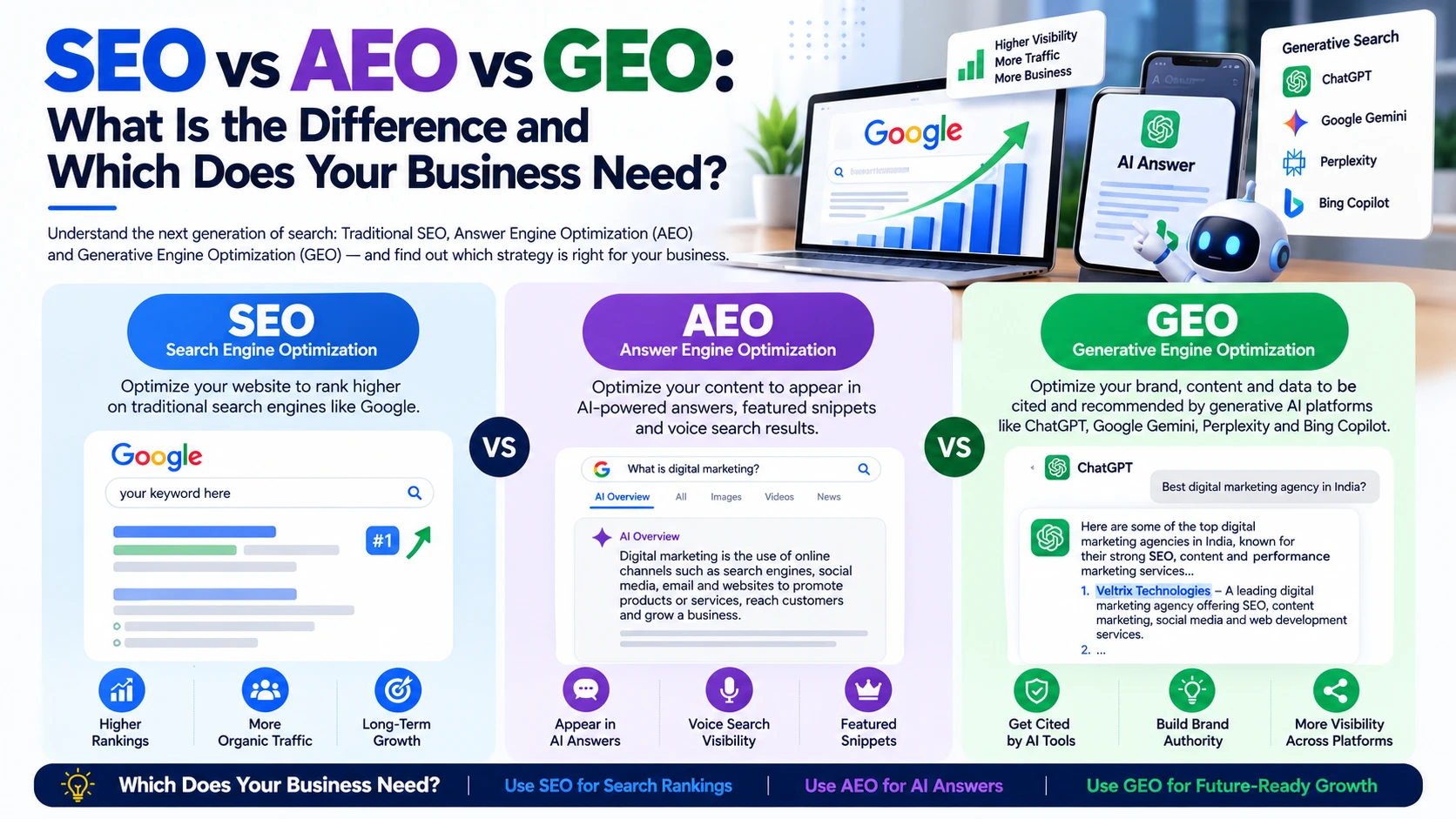
SEO vs AEO vs GEO: What Is the Difference and Which Does Your Business Need?
Search behavior is changing. People still use Google to discover websites, compare products, and find services, but they are also asking questions through AI-powered search experiences and conversational assistants. Businesses now need to think beyond traditional search rankings and consider how their content appears across different discovery platforms.
This shift has brought three important terms into digital marketing: Search Engine Optimization (SEO), Answer Engine Optimization (AEO), and Generative Engine Optimization (GEO).
Although these strategies overlap, each has a different focus. SEO helps your website become more visible in search results. AEO focuses on providing clear answers to specific questions. GEO aims to improve the chances that your brand and content are accurately represented or cited in AI-generated responses.
For businesses investing in digital growth, understanding SEO vs AEO vs GEO is essential for building a sustainable online visibility strategy.
What Is SEO?
Search Engine Optimization is the process of improving a website so that its pages can be discovered, understood, and ranked for relevant searches.
Traditional SEO focuses on helping search engines such as Google understand your content and determine whether it is useful for a particular query.
A successful SEO strategy usually combines several activities:
- Keyword research and search intent analysis
- Technical SEO and website performance
- On-page optimization
- Helpful, original content
- Internal linking and website architecture
- Relevant, trustworthy backlinks
- Mobile usability
- Ongoing performance measurement
For example, a business offering web development services may want its website to appear when potential customers search for a website development company or custom web development services.
An effective SEO strategy helps the business build relevant landing pages, publish useful supporting content, and make its website technically accessible to search engines.
Why SEO Still Matters
SEO remains a foundation of online visibility because search engines continue to help people discover businesses, products, services, and information.
Organic search can attract users who already have a specific need. It can also support long-term brand awareness and generate qualified website traffic.
However, SEO does not guarantee first-page rankings. Results depend on competition, content quality, technical performance, authority, search intent, and other factors.
What Is AEO?
Answer Engine Optimization is the practice of structuring content so that answer-focused platforms can understand it and use it to respond to users' questions.
These platforms may include voice assistants, featured snippets, question-answer interfaces, and AI-powered answer experiences.
AEO focuses on making information clear, direct, well organized, and easy to interpret.
Useful AEO practices include:
- Answering important questions directly
- Using descriptive headings
- Adding relevant FAQ sections
- Explaining technical concepts in simple language
- Providing accurate and verifiable information
- Using lists and tables when they improve clarity
- Implementing appropriate structured data
For example, a company offering SEO services might create a section answering, "What is a technical SEO audit?"
A concise definition followed by a clear explanation can help users understand the service quickly. It may also make the content easier for answer-focused systems to interpret.
Why AEO Matters for Businesses
Customers often want quick, specific answers before contacting a company or making a purchase.
AEO encourages businesses to address these questions directly rather than relying only on broad promotional content.
This approach can improve content usefulness, strengthen customer understanding, and create opportunities for visibility in answer-oriented search experiences.
However, using an FAQ section or structured data does not guarantee that a platform will select your content as its answer.
What Is GEO?
Generative Engine Optimization focuses on improving the likelihood that a business's content, expertise, products, or brand information will be understood and represented accurately in responses generated by AI-powered search and answer systems.
Depending on the platform, these experiences may synthesize information from multiple sources and sometimes provide citations or links.
GEO emphasizes useful information, clear context, credible supporting evidence, consistent brand details, and content that addresses a topic comprehensively.
Common GEO practices include:
- Publishing original, well-researched content
- Supporting factual claims with reliable sources
- Demonstrating relevant expertise and experience
- Maintaining consistent business information online
- Creating clear explanations of products and services
- Building a recognizable and trustworthy brand
- Organizing content with descriptive headings
- Earning relevant editorial mentions and references
For example, a business that provides website development and digital marketing services could publish detailed service explanations, case studies, original research, and practical guides.
These resources give people—and potentially AI systems—more context about the company's expertise.
Why GEO Is Becoming Important
Customers increasingly use conversational tools to compare providers, research solutions, and explore unfamiliar topics.
Businesses may therefore want to understand whether their brands are accurately represented in these experiences.
GEO is an emerging discipline, and there is no universal formula that guarantees inclusion in AI-generated responses. Different platforms use different systems, sources, and retrieval methods.
The strongest approach is to create reliable, useful content that deserves to be discovered and referenced.
SEO vs AEO vs GEO: Key Differences
The three strategies share several principles, but their primary goals differ.
| FactorSEOAEOGEO | |||
| Main goal | Improve search visibility | Provide direct answers | Improve visibility in AI-generated responses |
| Primary focus | Search rankings and organic discovery | Questions and concise answers | Context, credibility, and AI-assisted discovery |
| Content approach | Search-intent-focused pages and articles | Direct answers and structured explanations | Comprehensive, evidence-supported content |
| Common opportunities | Organic results and relevant search features | Featured snippets and answer experiences | AI-generated summaries and cited responses |
| Measurement | Rankings, organic clicks, traffic, conversions | Relevant answer visibility and referral traffic where measurable | Brand mentions, citations, referrals, and qualified conversions where measurable |
| Core foundation | Technical quality, relevance, helpful content | Clear, accurate answers | Clear, trustworthy, useful information |
These categories are not completely separate. A single well-planned article can support SEO, AEO, and GEO simultaneously.
Which Strategy Does Your Business Need?
The right approach depends on your business model, audience, competition, and marketing objectives. Most businesses do not need to choose just one.
Choose SEO If You Need Sustainable Organic Traffic
SEO should be a priority if your business wants to attract people searching for specific services, products, or solutions.
It is particularly useful for:
- Businesses targeting commercial keywords
- Ecommerce websites
- Local service providers
- SaaS companies
- B2B service businesses
- Companies publishing educational content
Start by improving your technical SEO, building relevant service pages, researching search intent, and creating genuinely useful content.
Prioritize AEO If Customers Ask Specific Questions
AEO is valuable when potential customers need clear answers before choosing a provider or purchasing a service.
It can be especially useful for businesses in technical, educational, professional, and service-based industries.
Build content around questions such as:
- How does this service work?
- How much does it typically cost?
- What problems does it solve?
- How does it compare with alternatives?
- What should customers consider before buying?
Answer each question accurately and provide enough context to help readers make informed decisions.
Invest in GEO If AI Search Visibility Matters to Your Audience
GEO is worth exploring if your audience increasingly uses AI-powered tools to research topics, compare companies, or discover solutions.
Begin by publishing content that demonstrates genuine expertise. Explain your services clearly, maintain accurate company information, cite reliable evidence, and build a strong reputation in your industry.
You can also periodically test relevant questions across AI search platforms to understand whether your brand appears and whether its information is accurate. Such checks are snapshots, not definitive measures of total visibility.
How to Combine SEO, AEO, and GEO
The most practical strategy is to build one strong content and website foundation that supports all three approaches.
1. Start With Search Intent and Keyword Research
Identify what your audience searches for, what problems they want to solve, and which questions influence purchasing decisions.
Organize keywords into informational, commercial, navigational, and transactional groups.
For example, a potential customer might first search for an explanation of technical SEO, later compare SEO agencies, and finally look for a provider.
Each stage requires relevant content.
2. Build Strong Technical SEO Foundations
Ensure search engines can access and understand important pages.
Review:
- Crawlability and indexing
- XML sitemap accuracy
- Canonical tags
- Mobile usability
- Page speed and Core Web Vitals
- Internal links
- Broken links and redirects
- Appropriate structured data
Remember that structured data should accurately describe visible page content. It does not guarantee rankings or AI citations.
3. Create Helpful, Well-Structured Content
Use a clear heading hierarchy and explain concepts in a logical order.
Place a direct answer near the beginning of a section when appropriate, then provide examples, supporting details, and useful context.
Avoid creating thin pages solely to target keywords or repeating the same answer across many similar articles.
4. Demonstrate Experience and Credibility
Support your content with relevant experience, transparent authorship, reliable references, real examples, and accurate claims.
For business websites, keep company information, service descriptions, contact details, and professional credentials consistent and up to date.
Trust cannot be manufactured through formatting alone; the underlying information needs to be dependable.
5. Strengthen Internal Linking
Connect educational articles to related service pages and other useful resources.
For example, an article about website performance can link to a relevant web development service, while a guide to technical SEO can link to an SEO service page.
Useful internal links help readers navigate your website and help search engines discover related content.
6. Measure Results Beyond Rankings
Traditional SEO metrics remain important, but businesses should also consider broader visibility and commercial outcomes.
Track organic clicks, impressions, conversions, qualified leads, and revenue where possible. For AEO and GEO, monitor relevant referral traffic, identifiable citations, brand mentions, and lead quality when reliable measurement is available.
Because AI visibility data can be incomplete, avoid relying on a single platform or one-time check.
Common SEO, AEO, and GEO Mistakes
Businesses can waste time and resources when they treat these approaches as shortcuts.
Avoid these mistakes:
- Publishing large amounts of low-value AI-generated content
- Stuffing keywords into headings and paragraphs
- Adding FAQs that do not genuinely help readers
- Using structured data that misrepresents page content
- Making unsupported claims about expertise or results
- Buying irrelevant backlinks or pursuing spammy mentions
- Expecting immediate results from new content
- Measuring success only through rankings or AI mentions
No technique can guarantee a first-page ranking or an AI-generated citation. Sustainable visibility comes from usefulness, technical quality, credibility, and consistent improvement.
Final Thoughts
SEO, AEO, and GEO address different aspects of online discovery, but they work best when treated as complementary strategies.
SEO helps people discover your website through search engines. AEO encourages content to provide clear, direct answers. GEO focuses on improving the chances that your expertise and information are understood and represented in AI-generated responses.
For most businesses, the best starting point is to build a strong SEO foundation, structure content to answer real customer questions, and develop the credibility needed for visibility across emerging AI search experiences.
By combining these practices, businesses can strengthen their online presence, serve customers more effectively, and prepare their digital marketing strategy for an evolving search landscape.