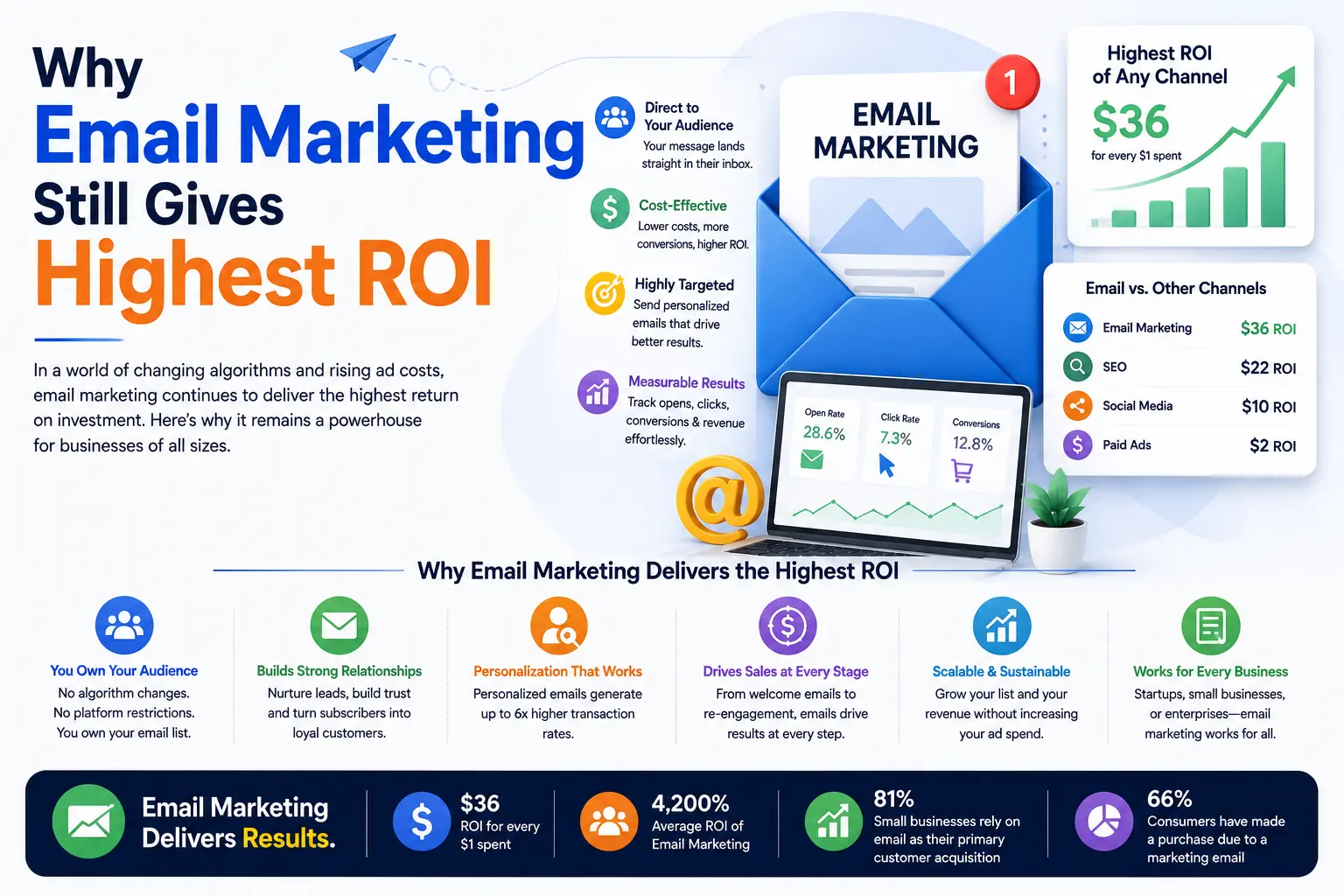
Why Email Marketing Still Gives the Highest ROI in Digital Marketing
Email marketing continues to be one of the most effective digital marketing channels for businesses of all sizes. While social media, paid advertising, search engine optimization, and other marketing channels have become increasingly popular, email remains a powerful way to communicate directly with potential and existing customers.
One of the biggest advantages of email marketing is its ability to generate strong returns without requiring a large advertising budget. Businesses can use email campaigns to nurture leads, promote products and services, increase repeat purchases, and build long-term customer relationships.
In 2026, email marketing is becoming even more effective as businesses combine personalization, automation, segmentation, and artificial intelligence to deliver more relevant messages.
What Makes Email Marketing So Effective?
Email marketing provides something many other digital channels cannot: direct communication with an audience that has already shown interest in a business.
When someone subscribes to a mailing list, downloads a resource, requests information, or makes a purchase, the business gains an opportunity to continue the relationship through email.
A well-planned email marketing strategy can help businesses:
- Generate qualified leads
- Increase customer retention
- Promote products and services
- Drive website traffic
- Recover abandoned purchases
- Build brand awareness
- Increase repeat sales
- Nurture potential customers
Unlike relying entirely on social media algorithms, businesses have greater control over their email audience and communication.
Why Email Marketing Can Deliver High ROI
Email marketing can produce strong ROI because the cost of reaching an existing subscriber is relatively low compared with many paid advertising channels.
A single campaign can potentially reach thousands of subscribers without requiring a separate advertising budget for every recipient.
The overall return depends on factors such as:
- Audience quality
- Campaign strategy
- Content quality
- Personalization
- Conversion rate
- Industry
- Email deliverability
- Customer lifetime value
For this reason, email marketing should not be viewed simply as a method of sending promotional messages. It should be treated as a long-term customer acquisition and retention strategy.
Email Marketing Helps Businesses Own Their Audience
Social media platforms are valuable for reaching new audiences, but businesses do not control those platforms or their algorithms.
An algorithm change can reduce organic reach overnight.
Email provides businesses with a more direct communication channel. Once customers voluntarily subscribe, businesses can communicate with them according to their preferences and consent.
This makes email marketing particularly valuable for long-term business growth.
Personalization Improves Email Performance
Generic emails are becoming less effective.
Modern customers expect businesses to understand their interests and provide relevant information.
Email personalization can include:
- Customer names
- Previous purchases
- Browsing behavior
- Product interests
- Location
- Industry
- Customer lifecycle stage
For example, an ecommerce business can recommend products based on previous purchases, while a software company can send educational content based on the customer's interests.
Relevant communication generally creates better engagement than sending the same message to everyone.
Email Segmentation Creates Better Results
Email segmentation means dividing an audience into smaller groups based on specific characteristics or behaviors.
Common segments include:
- New subscribers
- Existing customers
- High-value customers
- Inactive subscribers
- Potential leads
- Previous buyers
- Location-based audiences
Segmentation allows businesses to create more targeted campaigns.
For example, a new subscriber may receive an introductory email series, while an existing customer may receive product recommendations or loyalty offers.
Email Automation Saves Time
Email automation is one of the biggest advantages of modern email marketing.
Businesses can create automated campaigns that send messages based on specific actions.
Examples include:
Welcome Emails
Automatically introduce new subscribers to a business.
Lead Nurturing Emails
Educate potential customers before they make a purchasing decision.
Abandoned Cart Emails
Remind customers about products they left behind.
Follow-Up Emails
Maintain communication after a purchase or enquiry.
Re-Engagement Campaigns
Reconnect with subscribers who have stopped interacting with emails.
Automation allows businesses to maintain communication without manually sending every message.
AI Is Transforming Email Marketing
Artificial intelligence is making email marketing more intelligent and efficient.
AI-powered marketing tools can help businesses analyze customer behavior, identify audience segments, optimize content, and improve campaign timing.
AI can assist with:
- Subject line optimization
- Content personalization
- Audience segmentation
- Customer behavior analysis
- Campaign timing
- Product recommendations
- Performance analysis
The goal is not to replace marketers but to help them make better decisions using customer and campaign data.
Email Marketing Supports SEO and Website Growth
Email marketing and SEO are different channels, but they can work together effectively.
Businesses can use email campaigns to distribute:
- Blog articles
- Industry guides
- Research reports
- Case studies
- Product pages
- Educational resources
This can increase awareness of website content and encourage subscribers to visit important pages.
A strong content distribution strategy can support broader digital marketing objectives.
Email Marketing Works With Social Media Marketing
Businesses do not need to choose between email marketing and social media marketing.
The two channels can support each other.
For example, businesses can use social media to attract new followers and encourage interested users to join an email list.
Email subscribers can then receive exclusive content, offers, company updates, and educational resources.
A combined strategy creates multiple opportunities to engage with customers.
Email Marketing and Paid Advertising
Paid advertising can generate immediate traffic, while email marketing can help nurture the leads generated from those campaigns.
For example, a business can use Google Ads or social media advertising to attract potential customers to a landing page.
Visitors can then subscribe to an email list and enter a lead nurturing campaign.
This creates a complete marketing funnel:
Paid Advertising → Landing Page → Lead Capture → Email Nurturing → Conversion
Combining different marketing channels can improve the overall efficiency of customer acquisition.
Important Email Marketing Metrics to Track
Successful email marketing requires continuous measurement.
Businesses should monitor metrics such as:
- Open rate
- Click-through rate
- Conversion rate
- Bounce rate
- Unsubscribe rate
- Revenue per campaign
- Subscriber growth
- Email deliverability
These metrics help marketers understand what is working and where campaigns need improvement.
Instead of focusing on one metric, businesses should evaluate the complete customer journey from email engagement to conversion.
Common Email Marketing Mistakes to Avoid
Poor email campaigns can damage customer relationships and reduce ROI.
Common mistakes include:
- Sending emails too frequently
- Using misleading subject lines
- Buying email lists
- Ignoring mobile users
- Sending irrelevant content
- Failing to segment audiences
- Using excessive promotional language
- Not providing an easy unsubscribe option
Businesses should prioritize permission-based marketing, valuable content, and a positive subscriber experience.
Mobile Optimization Is Essential
A large percentage of users access email through smartphones.
If an email is difficult to read or interact with on a mobile device, potential customers may ignore it.
Mobile-friendly emails should include:
- Responsive layouts
- Readable text
- Clear buttons
- Short paragraphs
- Optimized images
- Simple navigation
Mobile optimization improves usability and can increase engagement.
How Businesses Can Improve Email Marketing ROI
Businesses can improve campaign performance by following a structured approach.
Build a Quality Email List
Focus on attracting people who genuinely want to hear from your business.
Create Valuable Content
Give subscribers useful information rather than constantly promoting products.
Segment Your Audience
Send relevant messages to specific customer groups.
Use Automation
Create automated campaigns for different stages of the customer journey.
Test Your Campaigns
Experiment with subject lines, content, calls to action, and sending times.
Track Conversions
Measure revenue and leads rather than focusing only on opens and clicks.
Continuously Optimize
Use campaign data to improve future marketing strategies.
Email Marketing for Small Businesses
Email marketing is particularly useful for small businesses because it can be implemented at a relatively manageable cost.
A small business can use email to:
- Promote new services
- Share special offers
- Build customer relationships
- Generate repeat purchases
- Nurture leads
- Promote blog content
When combined with professional SEO Services and other digital marketing strategies, email can become an important part of a sustainable customer acquisition system.
The Future of Email Marketing
Email marketing will continue evolving as artificial intelligence, automation, and personalization become more advanced.
Future email strategies will increasingly focus on:
- Hyper-personalized content
- Predictive customer behavior
- AI-assisted campaign optimization
- Automated customer journeys
- Better audience segmentation
- Real-time personalization
However, the fundamental principle will remain the same: provide the right information to the right customer at the right time.
Final Thoughts
Email marketing remains one of the strongest digital marketing channels because it combines direct communication, automation, personalization, and measurable results.
While no marketing channel guarantees a specific return for every business, email can deliver exceptionally strong ROI when campaigns are strategically planned and continuously optimized.
Businesses that build quality email lists, understand their audiences, create useful content, and use automation can develop stronger customer relationships while increasing leads, sales, and long-term revenue.
For maximum results, email marketing should be integrated with SEO, content marketing, social media marketing, website development, and other digital marketing strategies to create a complete online growth system.